
The discovery, a collaboration between the IAC Solar System Group and Light Bridges at the Teide Observatory, confirms the rotation period of Comet 3I/ATLAS
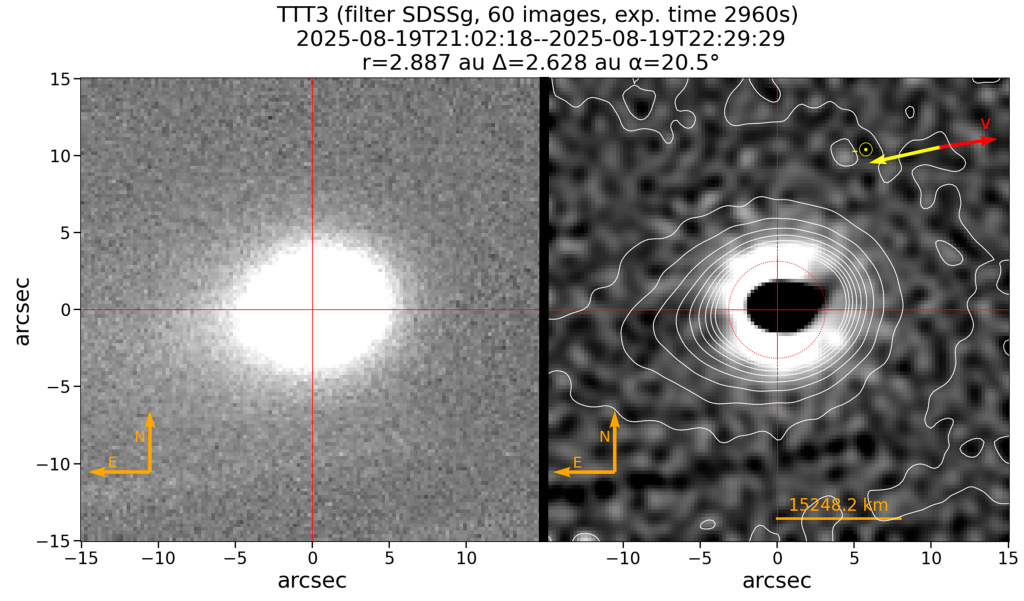
Santa Cruz de Tenerife, December 15, 2025 – The Two-meter Twin Telescope (TTT) has achieved a major breakthrough in astronomy: the first detection of a gas-and-dust jet and its periodic modulation in an interstellar comet, 3I/ATLAS.
The results are presented in the study “Pre-perihelion detection of a wobbling high-latitude jet in the interstellar comet 3I/ATLAS”, published in Astronomy & Astrophysics. This work provides the first direct evidence of localized activity on an interstellar cometary nucleus, offering unprecedented insight into the physical nature of a body formed outside our Solar System.
“An Extraordinarily Normal Interstellar Comet”
The research was led by Miquel Serra-Ricart, Scientific Director of Light Bridges. Co-authors include Javier Licandro, researcher at the Instituto de Astrofísica de Canarias (IAC), and Miguel R. Alarcón, IAC predoctoral researcher and Director of Scientific Operations at Light Bridges.
“In July, based on brightness variability in the coma, we were the first to propose a rotation period of about 17 hours,” explains Serra-Ricart. “We now report the first jet ever detected in an interstellar comet, which independently confirms that rotation period.”
Serra-Ricart: “3I/ATLAS is an extraordinarily normal interstellar comet”
Despite its extrasolar origin, the comet shows surprisingly familiar behavior. “3I/ATLAS is an extraordinarily normal interstellar comet,” adds Serra-Ricart, who served as administrator of the Teide Observatory for three decades. “Detecting this jet allows a direct comparison with the activity mechanisms observed in comets from our own Solar System.”
“Characterizing jets in a body like 3I/ATLAS is a unique opportunity to investigate the physical behavior of a pristine object formed in another planetary system,” notes Licandro.
Discovery and Nucleus Rotation
The key observations were obtained with the Two-meter Twin Telescope (ttt.iac.es) at the Teide Observatory (Tenerife) during an intensive 37-night campaign between July and September 2025 for the project PLANETIX25. The team pushed the limits of data storage and computing at ASTRO POC to analyze the inner coma structures of 3I/ATLAS, the third confirmed interstellar object.
Using an advanced image-processing technique based on Laplacian filtering, the researchers identified a faint but well-defined jet of gas and dust emerging from the nucleus—the first evidence of such a highly localized release of material from an interstellar nucleus.
Crucially, the jet was not static. Detailed analysis revealed a small but statistically significant periodic wobble around the nucleus rotation axis. This oscillation—the first ever detected in an interstellar comet—allowed the team to infer the nucleus rotation period. The results indicate a period of 14–17 hours, assuming the jet originates near one of the poles, in agreement with earlier measurements obtained in July using TTT data by researchers from the IAC, Gran Telescopio Canarias, and Universidad Complutense de Madrid (de la Fuente et al. 2025).
Scientific Significance
Cometary jets are key tracers of nucleus activity and rotational state. The success of this study relied on optimal image filtering techniques capable of enhancing faint, anisotropic jet structures against the bright and smooth coma background.
This advanced analysis provides new constraints on how volatiles and dust behave in bodies that have traveled through interstellar space, preserving material from the formation of an alien planetary system.
About Light Bridges
Light Bridges is a private research institution based in the Canary Islands, one of the world’s premier astronomical sites. Its activities focus on the operation of large robotic telescopes and massive astronomical data processing. Light Bridges combines frontier science with a strong commitment to environmental and financial sustainability, operating the newest robotic telescopes at the Teide Observatory, managed by the Instituto de Astrofísica de Canarias (IAC), together with high-performance computing centers for astronomy.
References
“Assessing interstellar comet 3I/ATLAS with the 10.4 m Gran Telescopio Canarias and the Two-meter Twin Telescope”
De la Fuente Marcos, R., Alarcon, M. R., Licandro, J., et al. 2025, A&A, 700, L9
DOI: https://doi.org/10.1051/0004-6361/202556439
“Pre-perihelion detection of a wobbling high-latitude jet in the interstellar comet 3I/ATLAS”
M. Serra-Ricart, J. Licandro, M.R. Alarcon, A&A, Forthcoming article
DOI: https://doi.org/10.1051/0004-6361/202558072
Arxiv: https://arxiv.org/abs/2512.12819

