
The Canary Islands emerges as a benchmark in the knowledge economy with Spain’s first industrial PhD in computing fully funded by a startup.
The University of La Laguna (ULL), the Institute of Technology and Renewable Energy (ITER), and the company Light Bridges are making significant strides in a pioneering industrial doctorate: GPU Applications for Astronomy in Massively-Multiplexed Optical Observatories. According to researcher Antonio Maudes, an expert in public-private partnerships, this is the first computing PhD in Spain to be fully funded by a startup. This milestone solidifies the viability of this cooperation model while leveraging the Canary Islands Special Tax Regime (REF).
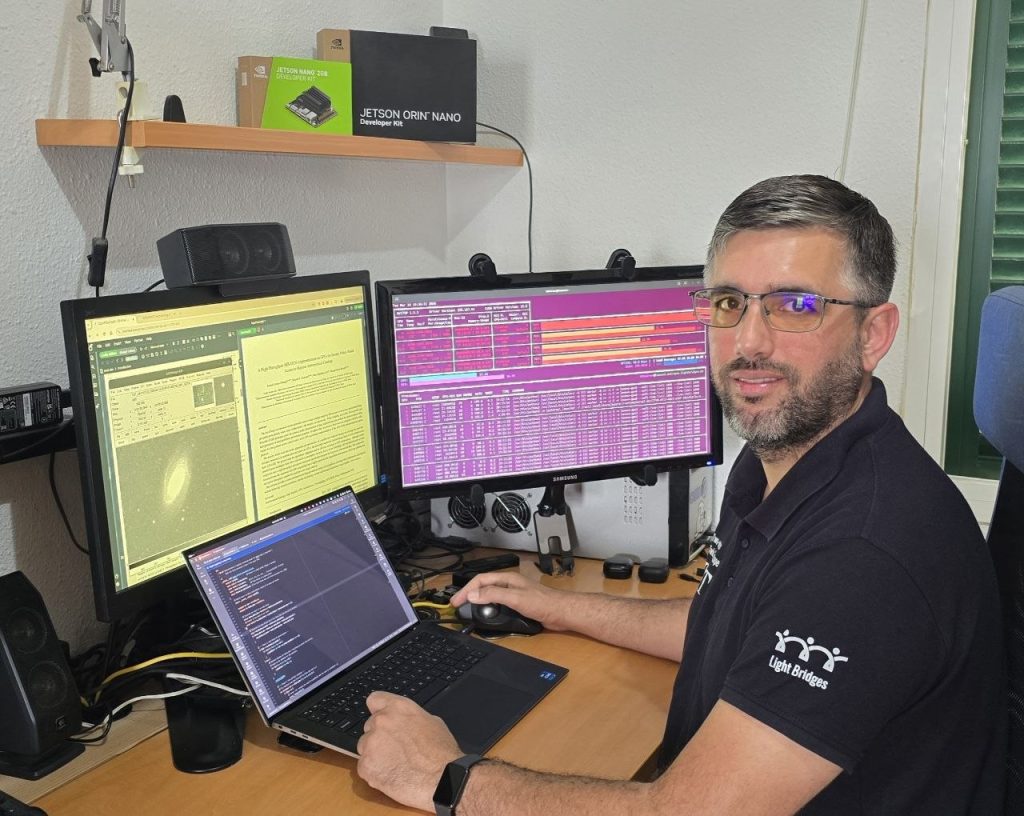
The project merges ULL’s academic excellence, ITER’s massive computing power, and Light Bridges’ cutting-edge research. “This collaboration between the University of La Laguna and the startup Light Bridges has proven to be an invaluable initiative,” explains Pino Caballero Gil, Professor of Computer Science and Artificial Intelligence at ULL. “It has enabled a ULL graduate, Samuel Lemes, to return to the university environment with a robust research objective.”
This industrial PhD has not only driven corporate innovation but has also allowed the company to tackle a practical security problem in astronomy with scientific rigor, “exemplary connecting doctoral research with the real-world needs of the sector,” the Professor adds.
Under the supervision of Caballero Gil and astrophysicist Miquel Serra-Ricart, Scientific Director of Light Bridges, the team recently announced its first research results. The study, with Lemes as lead author, addresses a critical challenge in modern astronomy: the efficient generation, processing, and access to massive astronomical image catalogs in robotic telescopes before they are used for science or officially published.
The paper has been submitted to a high-impact international journal and is currently under peer review. The preprint, titled “A High-Throughput AES-GCM Implementation on GPUs for Secure, Policy-Based Access to Massive Astronomical Catalogs,” can be accessed [here].
“One of the primary security issues addressed in this thesis is common in astronomical surveys that generate massive image catalogs. These require efficient and secure access, where data confidentiality and integrity are paramount,” says Caballero Gil.
To solve this, they developed an innovative framework combining advanced cryptography (using granular access control policies to ensure the integrity of scientific data) and GPU acceleration. By using graphics processors to implement high-speed encryption protocols, they have eliminated traditional bottlenecks in processing large data volumes, ensuring both integrity and traceability. This advancement is essential for complying with FAIR principles (Findable, Accessible, Interoperable, and Reusable) without compromising confidentiality during critical research phases.
The TTT: The Robotic Brain of Teide
The research has a direct application in the Two-meter Twin Telescope (TTT), managed by Light Bridges at the Teide Observatory. Featuring robotic telescopes of two meters and eighty centimeters, the TTT is currently the largest fully automated robotic infrastructure in the world.
“Thanks to GPU processing, TTT telescopes can deliver fully processed images within a maximum of one hour after observation”, Miquel Serra-Ricart (Light Bridges)
Thanks to a layered computational architecture, the TTT utilizes Artificial Intelligence to optimize its nightly scheduling, while GPUs handle synthetic tracking and precision photometry and astrometry processing. This industrial PhD allows the TTT to complement its scientific activity as an observatory with its technological goals, creating a unique technological testbed with twenty focal stations for the rapid validation of new instruments.
“Robotic telescopes are the future of modern astronomy. The only way to achieve high competitiveness is by extracting information from images as quickly as possible. Thanks to GPU processing, TTT telescopes can deliver fully processed images within a maximum of one hour after observation,” says Serra-Ricart, co-supervisor of the thesis.
A Model for the Future
Supported by ITER’s supercomputing infrastructure (part of the Tenerife Island Council) and the Light Bridges data center, this industrial PhD positions the Canary Islands as a benchmark in the knowledge economy and the smart use of the REF for R&D. It demonstrates that local startups have the capacity to spearhead research projects that solve global problems in strategic sectors such as aerospace, cybersecurity, and AI.
“I trust this fruitful collaboration will continue and expand in the future—for instance, in the field of quantum communication”, Pino Caballero (ULL)
“I trust this fruitful collaboration will continue and expand in the future—for instance, in the field of quantum communication, an area where both the company and the ULL Cryptology Research Group, which I lead, are specialists and have been working intensely for several years,” concludes Pino Caballero.

