
Check out the most recent Light Bridges’ annual scientific research projects
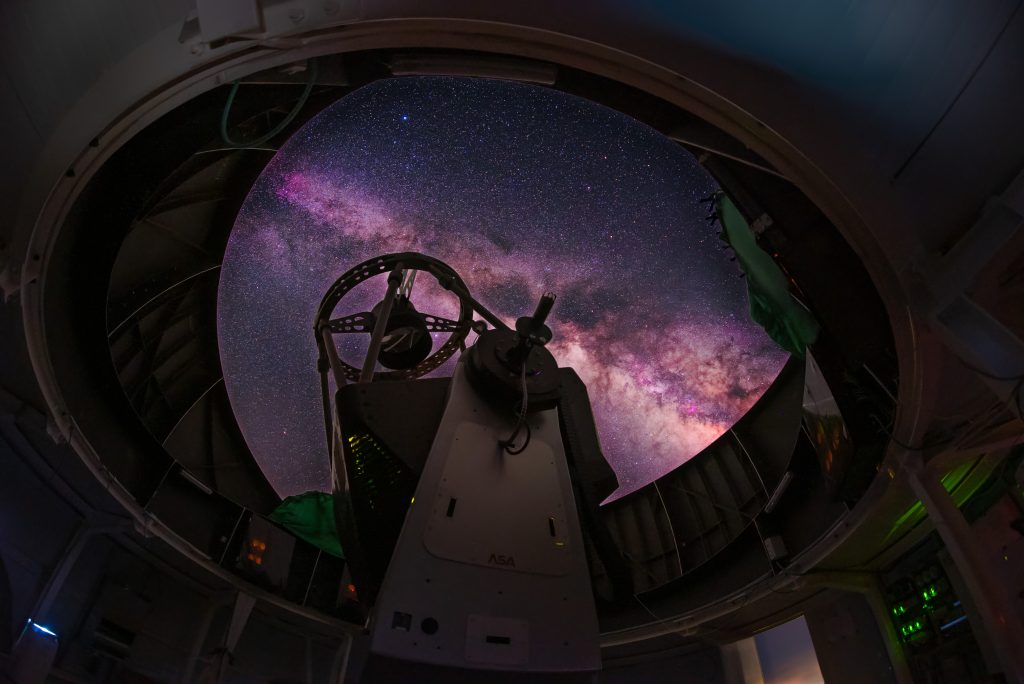
At Light Bridges, we pursue answers to the most challenging questions in the cosmos. Our scientific roadmap is defined by Light Bridges’ annual scientific research projects (PEI)—an advanced program designed to extract high-impact science from the Two-meter Twin Telescope (TTT) and the Transient Survey Telescope (TST) at the Observatorio del Teide (Tenerife, Canary Islands).
In 2026, we open new lines of inquiry under a strict “two-year fallow” rule, ensuring that each astronomy initiative explores a fresh scientific frontier and is positioned for competitive funding in year n+1.
Three Scientific Projects (PEI) to advance Astronomy in 2026
- FASTROTA26: Fast Rotation of Asteroids
Led by Miguel R. Alarcón, Director of Scientific Operations at Light Bridges, this project performs a deep dive into ultra-fast rotating asteroids (T < 2.5 h) and metallic bodies. By analyzing light curves and Sloan filters, the team aims to determine density and internal cohesion, revealing the structural secrets of “rubble piles”—vital data for future planetary defense and space missions.
- TNOESTRU26: Structure of Transneptunian Objects
Led by José Luis Ortiz, Senior Researcher at the Instituto de Astrofísica de Andalucía (IAA), this project focuses on the characterization of Transneptunian Objects (TNOs) through long photometric series and 3D modeling. By uncovering the densities, albedos, and rotational dynamics of these distant bodies, the research provides key insights into the formation of the outer Solar System and the origins of water ice and organic compounds. - CATGALDF26: A New Vision of Ten Historic Galaxies
Led by Ignacio Trujillo, Senior Researcher at the Instituto de Astrofísica de Canarias (IAC) and a world-renowned expert in low-surface brightness galaxy evolution. This project involves the ultra-deep re-observation of ten iconic galaxies (including M81 and M101) using our next-generation FERVOR/COLORS instruments. The goal is to detect hidden, low-brightness structures that have remained invisible to previous generations of technology.
Strategic Research Opportunities for the year ahead
Our annual framework is designed to host six flagship projects. As we finalized our 2026 cohort, Light Bridges has identifyed three additional frontier research groups whose objectives align with the unique capabilities of TTT and TST.
Light Bridges provides world-class infrastructure and operational expertise; we partner with exceptional scientific groups to advance the frontier of knowledge in astronomy.
We prioritize collaborations with highly-motivated teams that demonstrate:
Institutional Autonomy: A robust team structure, typically comprising a Principal Investigator, PhDs, and pre-doctoral researchers, with the internal resources to lead a high-level campaign.
Scientific Velocity: A proven track record of rapid data reduction and high-impact publication.
Programmatic Commitment: The capacity to execute a one-year intensive research phase, with a clear roadmap for securing subsequent funding (n+1) based on the results obtained.
For inquiries regarding project integration and technical specifications, please contact our scientific coordination team.

