
Researcher Óscar Soler details how the GRAVLENS25 project utilizes the continuous monitoring capabilities of the Two-meter Twin Telescope (TTT) to measure crucial temporal time delays in lensed quasars and validate cosmic models.
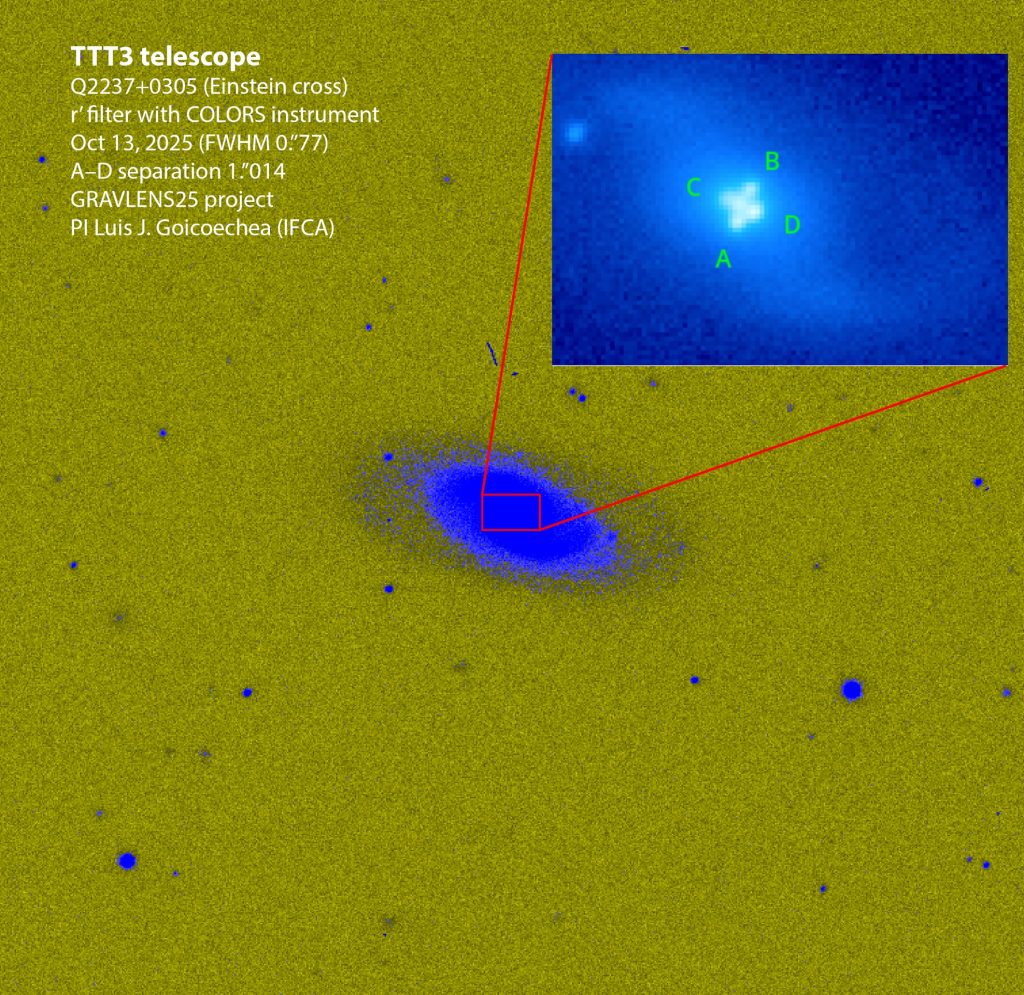
Gravitational lenses are a key cosmic phenomenon, predicted by Einstein’s Relativity, where massive structures (such as galaxies or Dark Matter) bend the light of distant objects, acting like a “cosmic magnifying glass.” This deviation effect not only magnifies objects that would otherwise be invisible, but in the case of quasars, it creates multiple images with different time delays. These measurements serve different cosmological purposes, such as mapping the distribution of Dark Matter or refining the constants that describe the expansion of the universe. The sky quality over the Canary Islands is essential for these high-precision observations, especially since the most interesting lenses are often faint objects requiring long exposures.
To capitalize on this potential, new robotic telescopes like the Two-meter Twin Telescope (TTT) play a strategic, complementary role to large survey telescopes. While large telescopes detect the lenses, the TTT can dedicate itself to continuous, long-term photometric monitoring of quasars to precisely measure those temporal time delays, as is done in the GRAVLENS25 project.
Óscar Soler, a young astrophysicist from the Universidad de La Laguna, is currently working as an ICEX VIVES fellow at the University of San Francisco with researcher Xiaosheng Huang, one of the world’s most relevant gravitational lens researchers.
Could you describe your current work with Professor Huang?
His group focuses on two main tasks: the discovery of new lenses using neural network algorithms applied to large surveys (such as the DESI survey), and the modeling of the physical system of a gravitational lens using machine learning.
Right now, I am learning all of that and looking at how their software works. Our goal is to model a specific gravitational lens with high definition images from the Hubble Space Telescope.
What will be the specific role of the Two-meter Twin Telescope (TTT) in this process?
We will use the TTT to perform photometric follow-up and experimentally measure the time delays obtained from the different lensed images of the same object. We are looking at gravitational lenses of quasars. Since they have variability, by comparing the variations in the signal of each image, we can obtain a temporal time delay. This delay gives us an idea of the difference in distance traveled by the light rays to compose each image.

Our intention is to use the model to obtain an estimate of that time delay and then compare it with the observational data we collect with the TTT.
Had you worked with gravitational lenses before?
I completed my Master’s in Astrophysics at the University of La Laguna, but I mainly focused my research on solar physics. I had worked with numerical simulations, so I am starting out in this field now.
How has this learning process been?
Well, in fields this deep, one is always learning new things. I started the phase of reading and getting into the digital world back in October in Tenerife. These two months have been a period where I’ve learned a great deal.
Why are gravitational lenses objects of such great interest?
They are essential because they provide a lot of information about objects that could not be seen without them, as they magnify the image tremendously. They allow us to see things that, due to their distance, we would not be able to appreciate.
Furthermore, perfecting our ability to create models and comparing them with real observations, helps us predict how these systems are much better, obtaining constraints about dark matter distribution in the lensing objects.
Another feature of great interest about gravitational lensing study is that it allows us to test the current cosmological models and measure the Hubble constant thanks to the previously mentioned time delay calculations.
What specific advantages does the TTT offer for this purpose, beyond its observing capacity?
The TTT is especially useful because it can perform follow-up on an object for a very long period without the need to request an entire three-month campaign.
“The TTT is especially useful because it can perform follow-up on an object for a very long period without the need to request an entire three-month campaign”
Future surveys will detect many of these objects. Having an instrument that works, like the TTT, and having it tested to perform follow-up on specific objects of interest that are discovered and quickly need to be observed… All of this can serve as proof to demonstrate the telescope’s capabilities.
Does the collaboration with the University of San Francisco have interests beyond scientific mentorship?
Yes. On one hand, the scientific collaboration is of clear interest for the group. On the other hand, together with the Canary Global Foundation, we are developing a course that will be imparted at the University of San Francisco next semester. There is considerable interest in using our facilities in Tenerife to bring astrophysics closer to the students there.
“There is considerable interest in using our facilities in Tenerife to bring astrophysics closer to the students” in USFCA
What are the main challenges when taking those images?
The objects I am currently looking at are quite faint. This requires many seconds of exposure. If the image quality due to atmospheric turbulence is not ideal, the image blurs immediately.
Does a database of gravitational lens images taken with the TTT already exist?
There is a gravitational lens follow-up project that has been running for a year. I am looking through that database to see what can be done. It will be very useful because these previous images will certainly serve as training for me to generate light curves until we have the temporal data for the lens of interest.

