
The instrument was first installed on the Liverpool Telescope in La Palma in 2015 to monitor Comet 67P. Light Bridges and Liverpool John Moores University are now collaborating on a LOTUS upgrade to enhace the TTT its spectroscopic capabilities
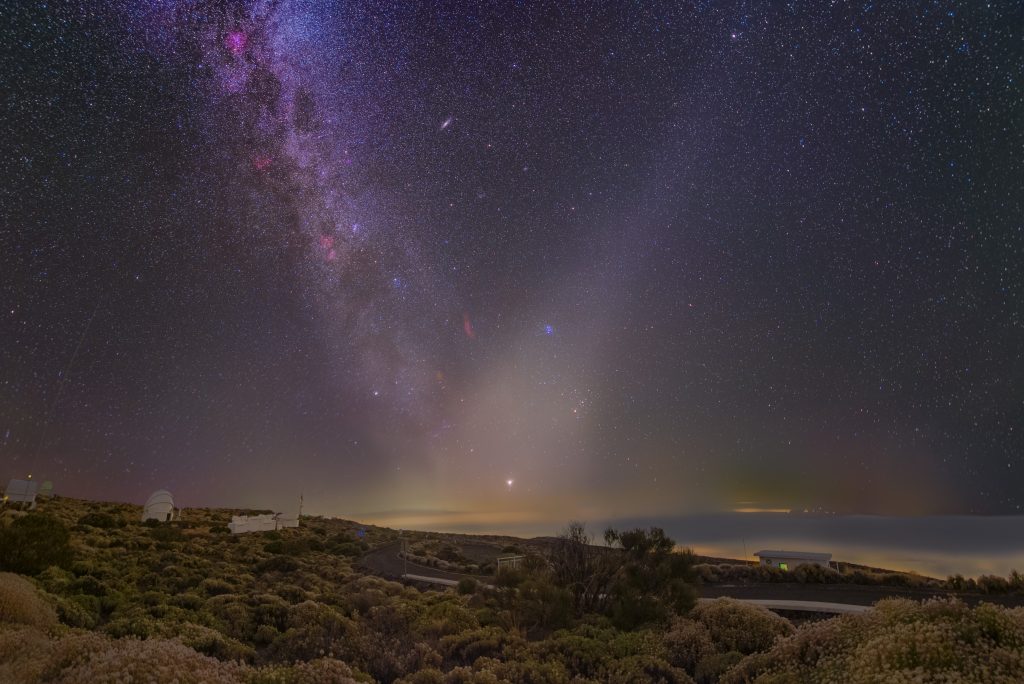
Robotic telescopes have transformed modern astronomy by enabling fast, autonomous observations across the globe. Among these, the Two-meter Twin Telescopes (TTT), managed by Light Bridges at the Teide Observatory in Tenerife, stand out for their flexibility and cutting-edge instrumentation. This year, in collaboration with the Liverpool John Moores University (LJMU), Light Bridges is preparing to enhance the TTT with a powerful new tool: the LOTUS spectrograph.
This collaboration exemplifies a win-win scenario for both parties. For LJMU, it offers an opportunity to test their spectrograph on a high-performing robotic telescope already producing scientific results. For Light Bridges, it adds a novel capability to the TTT, enabling astronomers to explore celestial phenomena in ways previously impossible.
From Liverpool to Tenerife: LOTUS’ Journey
The LOTUS (acronym of LOw-cosT Ultraviolet Spectrograph) was initially designed and installed on the Liverpool Telescope in La Palma in 2015, where it operated until 2019. According to Iain Steele, one of the project leads at LJMU, “LOTUS was originally built to observe comets, particularly in the ultraviolet range, to measure the chemical composition of the gas and dust released as they approached the Sun.” Its unique sensitivity in the ultraviolet spectrum allowed astronomers to detect molecules like CN and NH₃—key building blocks for understanding the formation of organic compounds in the solar system.
The instrument was conceived to complement the ESA Rosetta mission, which visited Comet 67P/Churyumov–Gerasimenko. While Rosetta provided an unprecedented close-up view of the comet, LOTUS allowed astronomers on Earth to monitor the same targets, offering a broader perspective and a valuable baseline for future comet observations.
After fulfilling its initial mission, LOTUS was decommissioned from the Liverpool Telescope. Yet, its capabilities remained highly relevant. “Since then, we have been collaborating with Light Bridges on several projects,” Steele explains. “This work is about proving that robotic spectroscopy can be carried out on another telescope, laying the groundwork for future spectrographs.”
“This work is about proving that robotic spectroscopy can be carried out on another telescope, laying the groundwork for future spectrographs”, Iain Steele (Liverpool John Moores University)
Installing LOTUS on the TTT presents the first opportunity to equip these telescopes with spectroscopic capabilities, opening new doors for robotic observation from the Canary Islands. And while LOTUS was originally developed with comets in mind, its potential is far broader. “Spectroscopy has a broad scientific reach — LOTUS is focused on comets, but we can also take spectra of stars, galaxies, gamma-ray bursts, and much more”, Steele notes.
Enhancing LOTUS for the TTT
Bringing LOTUS to the TTT is not as simple as transporting the instrument from one telescope to another. As Sofía Díez Ocharán, an ICEX VIVES fellow from Light Bridges working on the project at LJMU, describes, a detailed process of adaptation is required:
“We spent a month and a half at the IAC in Tenerife learning about spectroscopy, image reduction, and the basic handling of LOTUS. Here in Liverpool, we have been analyzing how the instrument evolved during its time on the Liverpool Telescope, testing it in a darkroom, and comparing it with the cameras we have on the TTT to ensure optimal performance.”
One key objective is to broaden LOTUS’ spectral range. Originally optimized for ultraviolet observations, the instrument will now be slightly adapted to cover a wider portion of the optical spectrum. This flexibility ensures that the upgraded TTT can support a wider variety of scientific programs beyond cometary studies.
“This will be the first spectrograph ever installed on the TTT,” Díez Ocharán notes. “It involves more than just placing the instrument on the telescope; we need to adapt documentation, calibration procedures, and the online interfaces so that scientists can use it efficiently from the start.”
The team is also conducting careful tests to identify any limitations and plan how to overcome them. These include developing automated calibration routines, evaluating acquisition performance, and ensuring that the instrument integrates seamlessly with the TTT’s robotic systems.
Pioneering Robotic Spectroscopy
LOTUS’ deployment on the TTT represents a significant technical achievement. Robotic spectroscopy is considerably more challenging than robotic imaging, as it requires precisely positioning the target on the spectrograph’s slit. Steele emphasizes:
“We proved that we can do robotic spectroscopy on the Liverpool Telescope, but now we want to see if it works with another robotic telescope like the TTT. This will test the technical performance of the system and ensure we can reliably perform spectroscopic observations.”
Once validated, this development could pave the way for future spectrographs to be designed in collaboration between LJMU and Light Bridges, extending the telescopes’ capabilities to study stars, galaxies, gamma-ray bursts, and other phenomena.
Another benefit is the possibility of cross-observations between La Palma and Tenerife. Although the telescopes are separated by several hundred kilometers, observations of the same targets can provide complementary perspectives and consistency checks, improving the reliability of scientific results.
A Win-Win Collaboration
The project highlights the symbiotic nature of modern astronomical collaborations. LJMU gains the opportunity to test an existing instrument under real observing conditions, refining its performance for diverse targets. Light Bridges, in turn, expands the utility of the TTT, adding a new type of observation that attracts a broader community of researchers.
“For the university, it’s about testing the instrument in real life and improving it,” Díez Ocharán explains. “For Light Bridges, it’s about enhancing the telescope with a new capability and opening it up to more scientists.”
“For the university, it’s about testing the instrument in real life and improving it. For Light Bridges, it’s about enhancing the telescope with a new capability and opening it up to more scientists”, Sofía Díez Ocharán (Light Bridges / ICEX VIVES fellow)
The collaboration also fosters international engagement, as the TTT becomes a platform for astronomers worldwide to pursue cutting-edge research. The teams’ work includes not only technical adaptation but also outreach and scientific networking, leveraging Liverpool’s vibrant academic environment.
Currently, LOTUS is undergoing final adjustments, supported by a grant from ACIISI — the Canary Islands Agency for Research, Innovation and the Information Society — awarded to RICTEL TTT, S.A., the owner of the TTT telescopes, and the teams are preparing for its integration with the TTT. Decisions on minor modifications and calibration procedures are still underway, but the project is progressing steadily. Once installed, LOTUS will allow the TTT to produce its first-ever spectroscopic data, complementing its imaging programs and offering astronomers a richer toolset for exploration.
In the longer term, the success of this collaboration could inspire additional upgrades, expanding the TTT’s role as a premier facility for robotic observations. It exemplifies how combining institutional expertise—instrumental know-how from LJMU and operational excellence from Light Bridges—can accelerate scientific innovation.
A New Era
The future introduction of LOTUS to the Two-meter Twin Telescopes demonstrates how collaborative efforts in astronomy can produce tangible benefits for both technology and science. By combining LJMU’s expertise in instrument development with Light Bridges’ experience in telescope operations, this project sets a precedent for enhancing robotic facilities with versatile, high-impact instrumentation.
As Steele summarizes: “This work is about proving that robotic spectroscopy can be carried out on another telescope, laying the groundwork for future spectrographs. Spectroscopy has a broad scientific reach — LOTUS is focused on comets, but we can also take spectra of stars, galaxies, gamma-ray bursts, and much more.”
With LOTUS, the TTT will soon not only capture images of the night sky but also unravel the chemical and physical properties of distant cosmic objects—marking a new era in robotic astronomy at the Canary Islands.

